


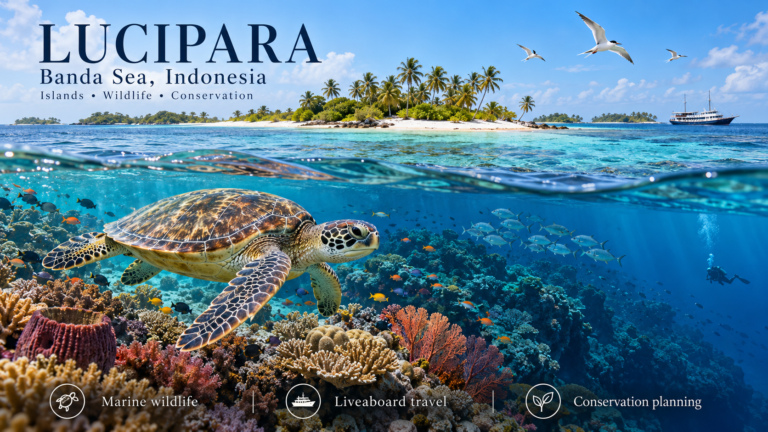
Lucipara refers to remote islands and surrounding reefs in Indonesia’s Banda Sea, within the Maluku region. Its sea turtles, coral habitats, and steep underwater walls have attracted divers and marine researchers. The name appears alongside Maisel and Penyu, with different sources describing the island groupings in different ways.
Reaching the area depends on boat access and suitable sea conditions. Local families have connections to the islands through traditional claims, coconut harvesting, and fishing. Conservation planning considers these activities alongside the protection of marine habitats, making Lucipara an interesting destination for travelers and an important area for ecological research.
What Does Lucipara Refer To?
In geographical and travel writing, Lucipara refers to remote islands and reefs in Indonesia’s Banda Sea. The name is associated with the Maisel and Penyu island groups in Maluku. Conservation reports sometimes apply it to a broader cluster than the smaller group described in general geographical references, which helps explain differences in island counts.
The spelling also appears in Euplexia lucipara, the scientific name of a moth. This is a separate use of the term. When an article discusses sea turtles, coral reefs, Ambon, or marine conservation, its subject is generally the Indonesian islands and their surrounding waters.
Quick Facts About the Islands
| Detail | Information |
|---|---|
| Name | Lucipara Islands |
| Country | Indonesia |
| Region | Maluku, also known as the Moluccas |
| Sea | Banda Sea |
| Distance From Ambon | Approximately 110 nautical miles, according to Coral Triangle Center |
| Island Groups | Maisel and Penyu in CTC’s broader geographical grouping |
| Number of Islands | Seven in CTC’s 2021 report |
| Landscape | Small coral islands, sandy beaches, reefs, and steep underwater walls |
| Notable Wildlife | Green, hawksbill, and loggerhead turtles, reef fish, sharks, and seabirds |
| Village Settlements | No villages recorded during CTC’s 2021 survey |
| Human Activities | Fishing, coconut harvesting, lighthouse operations, and marine research |
| Visitor Access | By boat, including liveaboard trips |
| Conservation Work | Surveys and zoning preparations documented in October 2026 as part of marine protected area planning |
Location in the Banda Sea and the Maluku Region
Lucipara is located in the Banda Sea in eastern Indonesia, within the Maluku region, also known as the Moluccas. Expedition accounts place the islands around 200 kilometers south of Ambon, the capital of Maluku Province. Coral Triangle Center describes the distance from Ambon as approximately 110 nautical miles.
Small coral islands, reef flats, and steep underwater walls characterize the area, with deep water separating it from larger settlements. Broader descriptions of Lucipara include both the Maisel and Penyu island groups. This remote offshore setting makes the sea crossing an important part of visiting, with weather and sea conditions influencing access.
Understanding the Maisel and Penyu Island Groups
Coral Triangle Center’s 2021 field report describes Lucipara as seven islands divided into two groups. The Penyu group includes Bingkudu, Kadola, and Mai. The Maisel group includes Maisel, Selatan, Karaungka, and Laponda. This grouping identifies the broader area examined during the organization’s conservation survey.
Some geographical references use Lucipara more narrowly, associating it with the Maisel Islands and describing Penyu as a neighboring group. Differences in scope can therefore contribute to the varying island counts found online. Checking which islands a source actually names helps readers understand whether it describes the smaller geographical group or the wider conservation area.
Alternative Spellings and Similarly Named Places
The Banda Sea islands appear in expedition accounts under names including Lousapara Islands, Lucapin Islands, and Lusipari Islands. Pulau-pulau Lucipara and Lucipara Eilanden are also recorded forms. These variations make location an essential part of identifying the intended island group.
Similarly spelled names can refer elsewhere. Edmund Roberts’s 1837 travel book mentions Lucepara on the approach to the Strait of Bangka, near Sumatra. The route described indicates a different location from the Banda Sea group. That passage therefore should not be treated as evidence that Roberts visited the Lucipara Islands in Maluku.
Sea Turtles, Nesting Beaches, and Seabirds
Sea turtles are a prominent part of Lucipara’s wildlife. Coral Triangle Center’s 2021 survey recorded mostly green turtles, alongside hawksbill and some loggerhead turtles. Expedition accounts also describe tracks along the sandy beaches and females coming ashore above the high-tide mark to attempt nesting.
The islands also provide nesting and roosting habitat for seabirds. Wetlands International’s inventory identifies greater crested terns among the birds using the Lucipara and Penyu groups. These records show why the shorelines matter alongside the reefs, supporting wildlife that depends on both land and sea. Conservation therefore involves protecting beaches as well as the surrounding marine environment.
Coral Reefs, Reef Fish, and Underwater Walls
The underwater landscape around Lucipara includes shallow reef flats and steep walls descending into deeper water. Coral Triangle Center’s field report describes soft and black corals, sea fans, barrel sponges, and overhangs. These features create a varied environment, with shallow coral habitats alongside vertical reef faces and sheltered spaces.
Recorded fish life includes schools of barracuda and trevally, along with groupers and other reef species. Rays and sharks also appear in expedition accounts, adding to the diversity described by researchers and visiting divers. These observations help explain the islands’ appeal for underwater exploration and marine research.
What the 2021 Conservation Survey Recorded
In April 2021, Coral Triangle Center conducted ecological and socioeconomic surveys in the Lucipara Islands aboard the Seven Seas liveaboard. The team surveyed seven islands over four days using the manta tow method. It reported more than 1,100 turtles, mostly green turtles, with hawksbill and some loggerhead turtles also recorded.
The report identified destructive fishing, plastic litter, and coral disease among the area’s conservation concerns. Researchers also met families who harvested coconuts and staff maintaining the lighthouse on Mai. The findings were intended to support marine protected area planning, combining wildlife observations with information about how people used the islands.
Local Families, Fishing, and Seasonal Island Use
Families with traditional connections to Lucipara have used the islands for coconut harvesting. Conservation and expedition accounts describe return visits and claims to the land. Coral Triangle Center’s 2021 survey reported no villages, but researchers met families using the islands and navigation staff associated with Mai’s lighthouse.
Fishing also connects the area with communities farther away. A Seven Seas account describes fishers from Ambon catching tuna and others from Wakatobi targeting reef fish around steep drop-offs and Skaro Reef. These activities help explain why conservation planning considers how families and fishers use the area alongside the protection of wildlife.
Marine Protection Plans and the 2026 Surveys
YKAN announced an integrated survey scheduled for October 15–29, 2026, involving Maluku’s marine and fisheries agency, Coral Triangle Center, and local partners. Planned work covered reefs, turtles, marine mammals, fisheries, and community resource use. The proposed marine protected area spans 388,712.10 hectares.
The survey was intended to support management and zoning plans required for formal designation by Indonesia’s central government. Provincial reservation of the area under Maluku’s 2025 spatial plan forms part of this process, while the announcement describes work toward national designation. General geographical background is available in the Lucipara Islands Wikipedia entry.
Diving, Snorkeling, and Liveaboard Visits
Expedition accounts describe divers exploring Lucipara’s steep reef walls and overhangs, while snorkelers follow the shallower reef flats. A Seven Seas account records turtles, trevally, barracuda, and reef sharks during snorkeling visits. Soft corals, sea fans, and sponges add further interest to the underwater landscape.
Liveaboard boats combine transport and onboard accommodation for journeys between these remote islands. They have also supported conservation expeditions, providing a base for researchers working across several sites. A voyage can include multiple diving or snorkeling stops, with the itinerary shaping how time is divided between locations. Sea conditions influence which sites are accessible during each visit.
Reaching Lucipara by Boat From Ambon
Ambon is a departure point documented in expedition accounts of Lucipara, approximately 200 kilometers away in the Banda Sea. A Seven Seas account published in 2021 estimated about 15 hours for the crossing. That estimate applied to a particular expedition, with journey times depending on the vessel, route, and sea conditions.
Liveaboard boats have provided transport, accommodation, and support for visitors and research teams making this offshore journey. Travelers should confirm the embarkation point, sailing dates, and whether the islands are included in their planned route. Provisions and arrangements for possible weather changes also form part of preparing for the crossing.
Weather, Sea Conditions, and Travel Timing
Monsoon winds influence travel conditions around Lucipara. Seven Seas lists March to April and October to December as favorable periods for diving in the wider Banda Sea. These regional windows provide a starting point for planning, while individual crossings depend on conditions along the route.
Winds, waves, and currents can affect both boat journeys and access to underwater sites. BMKG publishes Banda Sea marine forecasts that travelers should check close to departure, alongside the boat operator’s assessment. A flexible schedule allows for changes to crossings, beach landings, and diving or snorkeling activities when conditions require them.
Accommodation, Supplies, and What to Confirm Before Traveling
Published accounts of Lucipara expeditions describe accommodation aboard liveaboard vessels. Before booking, confirm cabin arrangements, meals, drinking water, and transfers. Seven Seas includes these in its published cruise terms, while local flights, hotel stays, and equipment rental involve separate charges.
Also check whether Lucipara appears in the actual itinerary, and review payment, cancellation, and itinerary-change terms. Divers should confirm certification and insurance requirements, while travelers with dietary needs or medication storage requirements should discuss arrangements in advance. A written breakdown of inclusions and extras helps clarify both the full cost and the practical requirements of the voyage.
Responsible Tourism and Protecting Marine Habitats
Divers and snorkelers should keep fins and equipment clear of coral and avoid chasing, touching, or feeding marine animals. Controlled movement in the water helps prevent accidental reef damage. Carrying a reusable bottle and taking rubbish back for proper disposal also helps reduce litter around the islands.
On nesting beaches, observe turtles from a distance and avoid shining lights at them or blocking their path. Leave seabird nests undisturbed and follow agreed landing arrangements. Ask operators how they manage waste, guide wildlife encounters, and brief guests about protecting marine habitats during each visit.
Euplexia lucipara: A Separate Use in a Moth’s Scientific Name
Euplexia lucipara is the scientific name of the moth commonly called the Small Angle Shades. The Natural History Museum records it as a species attributed to Linnaeus, 1758, and places it in the family Noctuidae. This name appears in insect identification guides, biological records, and species checklists.
The scientific record concerns insect classification and should be read in that context. The shared spelling alone does not establish a naming connection with Indonesia’s islands. Checking a source’s subject helps distinguish moth records from discussions of coral reefs, sea turtles, conservation, and travel in the Banda Sea.
Frequently Asked Questions
What is Lucipara?
It is a name used for remote islands and reefs in Indonesia’s Banda Sea, associated with the Maisel and Penyu groups in Maluku.
Where are the Lucipara Islands located?
They lie in eastern Indonesia’s Maluku region, roughly 200 kilometers south of Ambon. Expedition and conservation accounts place them in the Banda Sea.
How are the Lucipara, Maisel, and Penyu island groups connected?
Coral Triangle Center’s 2021 report describes a broader cluster containing both groups. Some geographical references apply the name more narrowly to the Maisel Islands.
How many islands are included in the group?
CTC’s 2021 survey covered seven islands: three in the Penyu group and four in the Maisel group. Other references may use different geographical boundaries.
Does anyone live on the islands?
CTC’s 2021 survey reported no villages. Families returned for coconut harvesting, and navigation staff worked on Mai, illustrating temporary or periodic human presence.
What wildlife is Lucipara known for?
Recorded wildlife includes green, hawksbill, and loggerhead turtles, greater crested terns, reef fish, rays, and sharks. Observations vary between sites and expeditions.
Can visitors go diving and snorkeling there?
Yes. Published expedition accounts describe diving along reef walls and snorkeling over shallow reef flats. Suitable activities depend on conditions, experience, and the operator’s itinerary.
How do travelers reach the islands?
Visitors have traveled by liveaboard or expedition boat, including departures from Ambon. A 2021 account estimated about 15 hours for one particular crossing.
When is the best time to visit Lucipara?
Seven Seas lists March to April and October to December for wider Banda Sea diving. Confirm local conditions with your operator. For further reading, visit Updated Magazine.
Is Lucipara officially designated as a marine protected area?
The October 2026 YKAN announcement described surveys and zoning work toward formal designation. It did not document a completed designation by Indonesia’s central government.
What is Euplexia lucipara?
It is the scientific name of the Small Angle Shades moth. The Natural History Museum records it in the family Noctuidae, attributed to Linnaeus, 1758.
Conclusion: Understanding Lucipara’s Islands, Wildlife, and Conservation
The islands bring together coral reefs, turtle nesting beaches, seabird habitats, and longstanding connections with families and fishers in Indonesia’s Banda Sea. Their remote setting makes boat access, sea conditions, and onboard arrangements central to planning a visit. Understanding the different island groupings also helps readers interpret maps and expedition accounts.
The 2021 findings and 2026 survey plans show the importance of field data and community participation in marine protection. Responsible visits involve care around reefs and nesting beaches, respect for local resource use, and attention to the operator’s guidance. These practices connect travel interest with the area’s conservation goals.
