


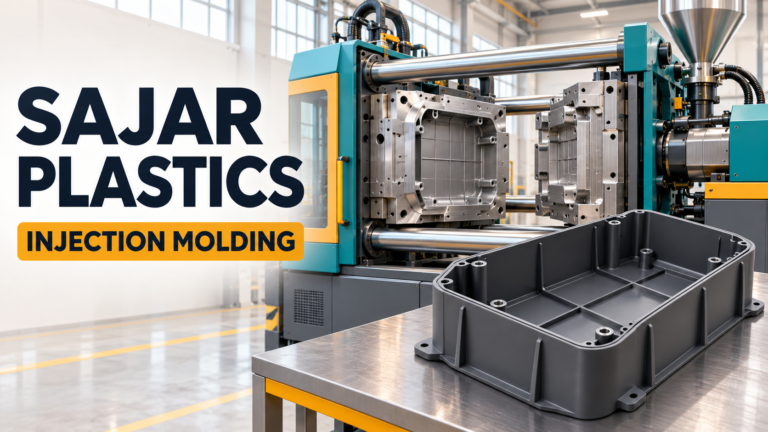
Sajar Plastics is a custom injection molding business founded in 1949 in Middlefield, Ohio. Universal Plastics acquired the company in 2017, and the facility now operates as Universal Plastics Middlefield. The plant specializes in large, complex plastic parts such as equipment housings, covers, and doors. It serves manufacturers of medical equipment, laboratory instruments, and retail kiosks, where molded parts often form the visible exterior of a machine.
The Middlefield plant helped develop gas-assist injection molding, a process it still offers today. In one version of the process, pressurized gas creates hollow channels in thicker areas of a part, reducing the amount of plastic needed for components such as large handles. The plant also offers conventional injection molding, structural foam molding, design support, painting, and assembly. For a customer ordering an equipment enclosure, that means the molded shell, paint finish, and assembly can all be handled at the same facility.
Sajar Plastics at a Glance
Sajar Plastics is the name associated with the Universal Plastics injection molding plant at 15285 South State Avenue in Middlefield, Ohio. The plant makes custom components that customers use in their own products. A manufacturer developing an equipment cover, for example, can bring its design to the Middlefield team for help preparing it for molding and sourcing the tool needed to make it. The facility works with customers ranging from startups to established equipment manufacturers.
Universal Plastics lists 17 molding machines at the Middlefield plant and a maximum part size of 70 by 80 inches. The facility handles smaller production runs as well as higher-volume orders. The part’s shape, material, and expected order quantity help determine which molding process and tooling suit the job. Customers can submit a request for a quote through Universal Plastics so the team can review those requirements for their specific project.
Its 1949 Founding and the Origin of the Sajar Name
Sajar Plastics began in Middlefield, Ohio, in 1949 with three machines for conventional injection molding. The presses injected molten plastic into molds to form parts for customers. As the business grew, it added equipment and expanded the plant to handle larger components with more complex shapes. In a company history published ahead of its 70th anniversary in 2019, Sajar reported that its manufacturing space had grown to about 150,000 square feet.
The name Sajar comes from the surnames of the three founders. Andrew Munson, the adviser who led the company’s 2017 sale, explained the spelling as “Sperry and Johnson and Radde.” The three surnames supplied the S, J, and R, while the two A’s came from the word “and.” The company carried that name into the 1980s, when it helped develop gas-assist injection molding.
The 2017 Acquisition and 2020 Universal Plastics Rebrand
Universal Plastics, a thermoforming company based in Holyoke, Massachusetts, bought Sajar Plastics in 2017 from Main Street Capital Holdings, which had owned it since 2008. The purchase added large-part injection molding to the group’s manufacturing services. Universal Plastics explained that some customers started with thermoformed parts and later moved to injection molding as their order volumes grew. With the Middlefield plant, the group could offer both processes at different stages of a product’s life.
On January 27, 2020, Universal Plastics announced that it had brought Sajar Plastics, Mayfield Plastics, and Premium Plastic Solutions together under the Universal Plastics name. The group also combined five websites into one, with technical guides, case studies, and a product gallery that customers could browse by manufacturing process or part type. That change explains why the former Sajar operation appears as Universal Plastics Middlefield in the company’s current facility listings.
The Middlefield, Ohio Plant and Its Large-Part Capacity
The molding presses at Universal Plastics Middlefield range from 85 to 1,500 tons of clamping force. That rating describes how much force a press can apply to hold the mold closed while molten plastic fills it. For a wide component such as an equipment door, the resin pushes against a large area inside the mold. The size of that area and the pressure needed to fill it both help determine which press can handle the job.
Universal Plastics also lists shot sizes from 5 to 291 ounces for its gas-assist equipment. A shot is the amount of resin injected in one molding cycle. Two covers with the same outside dimensions may need different shot sizes if one has thicker walls or molded-in supports. For a design near the plant’s published limit of 70 inches wide by 80 inches long, both the part’s shape and the amount of resin it needs factor into press selection.
Gas-Assist Injection Molding and Sajar’s Early Role
In internal gas-assist molding, pressurized nitrogen enters after an initial shot of molten plastic. The gas moves through selected thick sections, leaving hollow channels while pushing the resin against the mold walls. External gas assist applies pressure behind the part to hold its visible face against the mold as it cools. On a broad panel, that pressure can help reduce shallow dents called sink marks, which may form where a support rib meets the back of the panel.
Sajar Plastics was among the companies that helped develop gas-assist injection molding in the 1980s. The Plastics Hall of Fame records that inventor James Hendry developed an early internal gas process in 1981 and later worked with Sajar on gas-assist technology. Universal Plastics dates the plant’s Nitrojection development to 1985 and reports that the operation has since brought more than 500 gas-assisted parts into commercial production.
Structural Foam and Conventional Injection Molding
In structural foam molding, a blowing agent mixed into the molten resin creates small gas bubbles as the material expands in the mold. The result is a part with a cellular interior, formed at low molding pressure. Universal Plastics describes typical structural foam walls as roughly a quarter inch thick, a design suited to large covers and structural components. The process can leave swirls on the surface, so a part that will be visible on finished equipment may need sanding or painting.
Conventional injection molding uses pressure to fill a shaped mold with molten resin. The press holds pressure as the resin begins to cool, compensating for some of the shrinkage that occurs during cooling. Once the part is firm enough to release, the mold opens and the press ejects it. At Middlefield, the choice between conventional and structural foam molding depends on details such as wall thickness, the target weight, and the finish required on the visible surface.
Plastic Materials and Common Part Designs
Universal Plastics lists ABS, polycarbonate, nylon, polypropylene, and ABS/polycarbonate blends among its injection molding materials. These materials are thermoplastics, which soften when heated and solidify as they cool, taking the shape of the mold. ABS combines stiffness and impact resistance and comes in a range of colors and textures, making it suitable for many equipment housings. Clear grades of polycarbonate offer high impact strength where the design also calls for transparency.
Common part designs include equipment doors, cabinet covers, bezels, and large handles. The visible face and the back of a molded cover can serve different purposes. For example, the front can have a smooth finish while the back has reinforcing ribs and raised mounting points for fasteners. Molding those features into the cover can reduce the number of separate supports that need to be attached during assembly.
Medical Equipment, Laboratory Instruments, and Retail Kiosks
Universal Plastics’ injection molding gallery includes medical housings, bed rails, and components for diagnostic equipment such as mammography machines. In one published project, the company molded a contoured medical equipment door with a smooth face for easier cleaning and added a logo through pad printing. For a laboratory instrument housing, the design had to stay stable across wide openings so the molded shell could line up with adjoining parts during assembly.
The Middlefield plant also serves manufacturers of automated kiosks, registers, and dispensing machines. Universal Plastics lists kiosk covers among its products, and its injection molding gallery includes related retail components such as cash drawers and lottery machine covers. On a self-service kiosk, a molded front panel can frame the screen and payment controls. Its openings need to align with the hardware behind them, while its color and texture form part of the machine’s customer-facing design.
Medical Tray Case Study on Switching From Structural Foam to Gas Assist
A medical equipment customer wanted to redesign a structural foam tray that required fabrication and finishing after molding. The goal was a strong, seamless tray with a consistent surface and fewer finishing steps. Sajar Plastics worked with the customer’s design team to produce the tray as a single gas-assisted part. The redesign reduced the overall wall thickness and used molded-in ribs and gas channels to give the tray the stiffness it needed.
The new mold gave the tray its surface texture during molding, eliminating the need for sanding, priming, and texture painting. Universal Plastics says the conversion also removed the cosmetic repair previously needed around the point where plastic entered the structural foam mold. The company reports that the redesigned tray weighed less and that the shorter finishing sequence supported higher production rates and a more consistent supply.
Design Support, Mold Tooling, and Tool Sourcing
Universal Plastics offers design support early in an injection molding project, when engineers and customers can review how the part and mold will work together. The company uses modeling software such as SolidWorks and Pro/ENGINEER to check designs before tooling is built. In one project for a piece of medical equipment with several components, the team grouped related parts in shared molds. That reduced the number of molds needed and helped control upfront tooling costs.
The injection molding operation lists global tool sourcing, which gives the Middlefield team access to outside toolmakers for new molds. Customers moving an existing mold can use Universal Plastics’ tool transfer program, which includes a checklist and support from engineers and project managers. Once a mold enters production, the company tracks its preventive maintenance schedule electronically so the team can plan service before wear affects part quality.
In-House Painting, Printing, and Assembly
Universal Plastics lists nine paint booths and an automated paint line at its Middlefield injection molding plant. One booth uses heated nitrogen to help coats dry faster, and the team can apply textured finishes with solvent-based or water-based paints. The plant also uses pad printing to add logos, instructions, and other markings directly to molded parts. For a control panel, a customer can specify both the paint texture and the printed symbols that identify buttons or switches.
Assembly services include ultrasonic welding and heat staking. Ultrasonic welding uses high-frequency vibrations to create heat at the joint and fuse compatible plastic pieces. Heat staking reshapes the end of a molded plastic post so it can hold another component in place, such as a bracket inside a housing. Universal Plastics also lists packaging and shipping among its injection molding services, so customers can order assembled units prepared for delivery.
ISO 9001:2015 Certification and Part Inspection
DEKRA Certification issued the Middlefield plant’s ISO 9001:2015 certificate for its quality management system. The scope covers custom injection molding, including large, complex parts often made with gas assist, as well as selected post-molding and engineering services. The published certificate lists January 11, 2028, as its expiry date. ISO has since published its 2026 edition and says organizations certified to the 2015 edition have three years to transition.
For part inspection, Universal Plastics lists a 3D scanner and a coordinate measuring machine. These tools can check features such as the width of an opening or the position of mounting holes against the dimensions on a drawing. The plant also lists a spectrophotometer for measuring color and a gloss meter for measuring surface sheen. When two painted panels sit side by side, those readings help check that both finishes meet the same specification.
How to Contact the Middlefield Plant and Request a Quote
Call Universal Plastics Middlefield at (440) 632-5203 to reach the injection molding operation. Universal Plastics also lists (800) 927-8664 as its toll-free injection molding number. The plant is at 15285 South State Avenue, Middlefield, OH 44062. If your part is still in development, you can call to discuss its size, intended use, and production volume before choosing a molding process.
To request a quote online, use the Request for Quote page and identify the project as injection molding for the Middlefield plant. Have a drawing or CAD model ready if available, along with the part dimensions, preferred material, expected order quantity, and any painting or assembly requirements. Mention whether you have an existing mold or need new tooling. Universal Plastics quotes lead times job by job, so include your target delivery date in the request.
Frequently Asked Questions
What does Sajar Plastics do?
Sajar Plastics makes custom plastic parts such as equipment housings, covers, doors, and handles. The Middlefield plant offers conventional injection molding, gas-assist injection molding, and structural foam molding.
What does the name Sajar stand for?
Sajar stands for Sperry and Johnson and Radde. The name combines the initials of the three founders’ surnames with an A for each “and.”
When was Sajar Plastics founded?
Sajar Plastics was founded in 1949. It began operations with three conventional injection molding machines.
Where is the Sajar Plastics facility located?
The facility is at 15285 South State Avenue, Middlefield, OH 44062.
Is Sajar Plastics now called Universal Plastics Middlefield?
Yes. Universal Plastics acquired Sajar Plastics in 2017 and brought it under the Universal Plastics name in 2020. The company now lists the plant as Universal Plastics Middlefield.
How does gas-assist injection molding differ from structural foam molding?
Internal gas-assist molding uses pressurized gas to form hollow channels in selected areas of a part. External gas assist uses pressure behind the part to hold its visible surface against the mold. Structural foam molding uses a blowing agent to create many small gas cells throughout the resin.
How large are the parts the Middlefield plant can produce?
Universal Plastics lists parts up to 70 inches wide by 80 inches long. The choice of press also depends on the part’s shape, the amount of resin needed, and the force required to hold the mold closed.
Which industries does the Middlefield plant serve?
The plant serves manufacturers of medical equipment, laboratory and diagnostic instruments, industrial equipment, and retail systems such as kiosks, registers, and dispensing machines.
Does the facility offer painting and assembly?
Yes. Middlefield offers in-house painting, pad printing, and assembly. Its assembly services include ultrasonic welding and heat staking.
Is Universal Plastics Middlefield ISO 9001 certified?
Yes. The plant’s published DEKRA certificate covers its quality management system under ISO 9001:2015. It applies to custom injection molding and selected related services and lists January 11, 2028, as the expiry date.
How can you request an injection molding quote?
Use the Request for Quote page on the Universal Plastics website or call the Middlefield injection molding line at (440) 632-5203. Have a drawing or CAD model ready if available, along with the expected order quantity and any finish or assembly requirements.
Conclusion
Sajar Plastics built its business in Middlefield around large molded parts that needed to meet both structural and appearance requirements. Its medical tray project shows how those requirements can shape the mold. Thinner walls and molded-in ribs produced a lighter tray, while adding the surface texture during molding cut several finishing steps. That combination of part design, molding, and finishing remains central to the work Universal Plastics Middlefield describes today.
The plant’s published press ratings and part dimensions give manufacturers a starting point for assessing a design. A project review can then cover the expected production volume, any existing tooling, and the finish or assembly the component needs. For a part that must fit alongside other pieces, the drawing can also identify the dimensions, color, and gloss that the team will need to check before delivery.
