


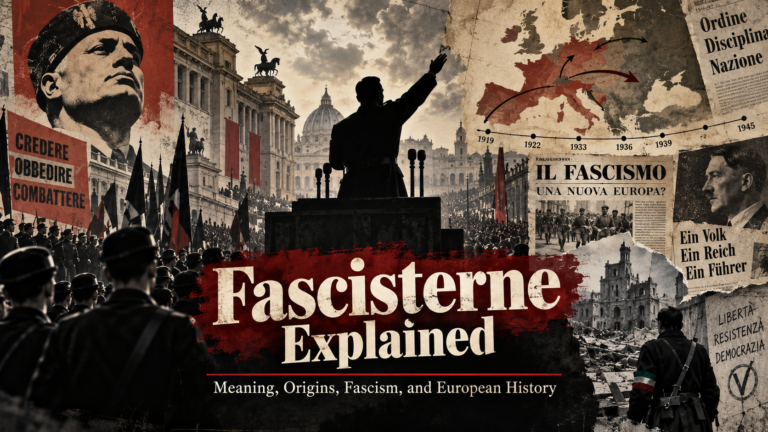
Fascisterne is a Danish word that translates to “the fascists” in English. It refers to people who support fascism, a political ideology associated with authoritarian leadership, extreme nationalism, and opposition to democratic institutions. Although the term comes from Danish vocabulary, its historical significance connects closely with the political movements that transformed Europe during the twentieth century.
The rise of fascism began in Italy under Benito Mussolini, whose movement gained influence following World War I. Fascist ideas later spread across Europe, shaping political organizations and influencing developments in countries such as Germany and Denmark. These movements promoted strong centralized authority, used propaganda to gain support, and restricted political opposition.
Understanding Fascisterne requires exploring both its linguistic meaning and historical background. This article examines the origins of fascism, its central beliefs, its influence on European history, and the role of fascist movements during World War II. It also explains how the Danish term appears in modern political discussions.
What Does Fascisterne Mean in Danish?
Fascisterne is a Danish term that directly translates to “the fascists” in English. It describes a specific group of people associated with fascism, a political ideology characterized by authoritarian government, extreme nationalism, and opposition to democratic principles. The word itself does not identify any particular political party or historical organization.
In Danish grammar, “fascist” refers to one supporter of fascism, while “fascister” is the plural form meaning “fascists.” Adding the ending “ne” creates the definite plural form, referring to “the fascists.” This distinction is important when interpreting Danish historical documents, political discussions, and newspaper articles.
The term can describe followers of Benito Mussolini’s movement in Italy, members of European fascist organizations, or individuals associated with similar political beliefs. Its precise meaning depends on the surrounding context. Unlike “fascisme,” which refers to the ideology itself, Fascisterne specifically identifies its supporters.
Understanding the Danish Grammar Behind Fascisterne
Understanding the grammar behind Fascisterne helps explain how Danish identifies people and groups. The word comes from the noun “fascist,” which describes an individual who supports fascist ideology. Danish nouns change their endings according to number and whether they refer to someone generally or to a specific person or group.
The singular indefinite form is “en fascist,” meaning “a fascist,” while “fascisten” means “the fascist.” The plural indefinite form, “fascister,” translates to “fascists.” Adding the definite ending creates “fascisterne,” meaning “the fascists.”
Unlike English, which usually places “the” before a noun, Danish commonly expresses definiteness through grammatical endings. This feature makes the word’s structure especially important when translating historical texts.
Recognizing these differences allows readers to interpret Danish political writing more accurately and distinguish references to individual supporters from discussions about identifiable groups.
Historical Origins of the Fascist Movement
The fascist movement emerged in Italy during the political and economic instability that followed World War I. Although its ideological roots extended into the late nineteenth century, fascism developed into an organized political movement in 1919. Rising unemployment, social unrest, and disappointment with the postwar settlement created conditions in which radical political movements could attract support.
On March 23, 1919, Benito Mussolini established the Fasci Italiani di Combattimento in Milan. The organization attracted war veterans, nationalists, and individuals frustrated with Italy’s existing political system. Its supporters increasingly promoted aggressive nationalism, strong leadership, and opposition to socialism and parliamentary democracy.
The movement gained influence through political campaigning, organized intimidation, and violence against opponents. In 1921, it developed into the National Fascist Party, strengthening Mussolini’s political position.
These developments marked an important turning point in European history. Italian fascism established a model of authoritarian politics that later influenced extremist movements in several other countries.
Benito Mussolini and the Rise of Italian Fascism
Benito Mussolini played a central role in transforming Italian fascism from a political movement into an authoritarian government. A former socialist journalist, he gradually embraced extreme nationalism and presented himself as a leader capable of restoring Italy’s political stability. His supporters, known as Blackshirts, used organized violence and intimidation against political opponents.
In October 1922, Mussolini’s movement organized the March on Rome, pressuring Italy’s political leadership. King Victor Emmanuel III refused to authorize military action against the fascists and instead appointed Mussolini as prime minister. This decision allowed him to enter government through a constitutional appointment backed by the threat of violence.
Over the following years, Mussolini weakened democratic institutions and concentrated political authority. The 1924 murder of socialist politician Giacomo Matteotti exposed the regime’s growing repression. By 1925, Mussolini was openly establishing a dictatorship that restricted opposition parties, press freedom, and parliamentary independence. His government became an influential example for other authoritarian movements across Europe.
Core Beliefs and Characteristics of Fascist Ideology
Fascist ideology is built around extreme nationalism, authoritarian leadership, and the belief that national interests should take priority over individual freedoms. Unlike democratic systems that encourage political competition and public participation, fascist movements favor concentrated authority under a powerful leader or ruling party.
One defining characteristic is the rejection of political pluralism. Fascist governments typically restrict opposition parties, limit freedom of expression, and weaken independent institutions. They often present political disagreement as a threat to national unity rather than a normal part of public life.
Militarism is another important feature. Fascist movements frequently glorify military strength, discipline, and sacrifice while portraying national expansion as a sign of greatness. They also promote social hierarchies and may exclude groups considered outsiders from their vision of national identity.
Although fascist movements developed differently across Europe, these shared characteristics help historians distinguish fascism from ordinary nationalism, conservatism, and other political ideologies.
How Fascist Governments Used Propaganda and Control
Fascist governments relied heavily on propaganda to influence public opinion and strengthen their political authority. In Mussolini’s Italy, newspapers, radio broadcasts, films, and public speeches promoted loyalty to the state. Government-controlled messaging portrayed Mussolini as a powerful national leader while presenting fascism as the solution to Italy’s political and economic problems.
Censorship worked alongside propaganda to suppress criticism. Independent newspapers faced restrictions, opposition publications were closed, and journalists were pressured to follow government-approved narratives. Public rallies, patriotic symbols, and carefully organized ceremonies helped create an image of national unity and widespread support.
Education also became an important instrument of political influence. Schools introduced lessons emphasizing obedience, nationalism, and loyalty to the ruling government. Youth organizations encouraged participation in activities designed to promote fascist values.
Similar methods appeared in Nazi Germany, where propaganda and censorship supported racial persecution and political repression. These practices demonstrated how authoritarian governments could manipulate information while limiting opportunities for independent thought and public disagreement.
Fascism vs Nazism: Key Historical Differences
Fascism and Nazism were closely related authoritarian ideologies that shaped European politics during the twentieth century. Both rejected liberal democracy, promoted extreme nationalism, and relied on powerful leaders, propaganda, and political repression. However, their ideological priorities and historical development differed in important ways.
Italian fascism under Benito Mussolini initially emphasized national unity, state authority, militarism, and the restoration of Italian power. Nazism, led by Adolf Hitler in Germany, placed racial hierarchy and antisemitism at the center of its political worldview. Nazi ideology promoted the false belief in Aryan racial superiority and pursued territorial expansion through racial conquest.
Although antisemitism was not initially central to Italian fascism, Mussolini’s government introduced discriminatory racial laws in 1938. Nazi Germany had already established extensive antisemitic legislation, including the Nuremberg Laws of 1935.
The most devastating distinction was the Nazi regime’s systematic genocide of six million European Jews during the Holocaust. Understanding these differences helps explain why Nazism is generally recognized as a particular form of fascism rather than an entirely separate political tradition.
How Fascist Ideas Spread Across Europe
Fascist ideas spread across Europe during the 1920s and 1930s as countries struggled with economic difficulties, political instability, and social divisions. Mussolini’s success in Italy encouraged nationalist organizations elsewhere to adopt similar approaches to leadership, political organization, and public mobilization.
In Britain, Oswald Mosley founded the British Union of Fascists in 1932, promoting authoritarian nationalism and opposing parliamentary politics. Romania witnessed the growth of the Iron Guard, an extremist movement associated with antisemitism, political violence, and religious nationalism. Spain’s Falange also adopted fascist principles, combining authoritarian politics with Spanish nationalism.
Germany experienced the most significant expansion of fascist power outside Italy when Adolf Hitler became chancellor in 1933. Other movements emerged in Hungary, Austria, and several European countries.
Although these organizations shared certain ideological characteristics, their goals, public support, and political influence differed. Some gained government authority, while others remained relatively small opposition movements.
The Rise of Fascist Movements in Denmark
Denmark experienced the influence of fascist and nationalist movements during the political uncertainty of the 1920s and 1930s. Although the country maintained democratic institutions, several small extremist organizations emerged, criticizing parliamentary politics and promoting authoritarian ideas. Developments in neighboring Germany helped bring these movements greater attention.
One of the most significant developments occurred on November 16, 1930, when Cay Lembcke founded the Danish National Socialist Workers’ Party (DNSAP). The organization adopted many ideas from Adolf Hitler’s German Nazi Party, including extreme nationalism, antisemitism, and opposition to parliamentary democracy.
In 1933, Frits Clausen became the party’s leader and worked to expand its activities through political publications, youth organizations, and public campaigns. However, Danish fascist movements struggled to attract widespread electoral support.
Despite their limited influence, these organizations demonstrated how authoritarian ideologies reached Denmark during a period of growing political tensions across Europe.
Danish Nazi Politics and the DNSAP Movement
The Danish National Socialist Workers’ Party (DNSAP) became the country’s most prominent Nazi political organization during the 1930s and World War II. Under Frits Clausen, the party closely followed German National Socialism, adopting similar political symbols, organizational methods, and antisemitic policies. Its leadership promoted authoritarian government and sought to replace Denmark’s parliamentary system.
Despite its activities, DNSAP struggled to gain widespread public support. In the 1939 parliamentary election, the party received approximately 1.8% of the vote and secured three seats in the Folketing, Denmark’s parliament.
Following Germany’s occupation of Denmark in April 1940, party leaders hoped to gain political power with German assistance. DNSAP also supported recruitment into German military organizations, including the Waffen-SS.
However, its electoral influence remained limited. Even in the 1943 election, the party won only three parliamentary seats, receiving approximately 2.1% of the vote. Its political ambitions ultimately failed despite support from the German occupation authorities.
Fascisterne During World War II
When Nazi Germany occupied Denmark on April 9, 1940, Danish fascist and Nazi organizations hoped to gain greater political influence. The occupation created opportunities for extremist groups to cooperate with German authorities, although Denmark’s existing government initially continued operating under a policy of cooperation.
Members of the Danish National Socialist Workers’ Party supported German wartime objectives through political activities, intelligence gathering, and military recruitment. In 1941, the party helped recruit volunteers for Frikorps Danmark, a Danish military unit attached to the German Waffen-SS. These volunteers later fought against Soviet forces on the Eastern Front.
However, Danish Nazi organizations never gained widespread public support or control of the national government. Their association with the occupying forces became increasingly controversial as resistance activities expanded.
Following Germany’s defeat in May 1945, the DNSAP dissolved. Individuals involved in wartime collaboration faced public criticism, investigations, and, in some cases, criminal prosecution for their activities during the occupation.
Danish Resistance and the Decline of Fascism
The Danish resistance movement became increasingly active during World War II as opposition to German occupation intensified. Resistance groups organized sabotage operations, distributed underground newspapers, and gathered intelligence for the Allied forces. These activities challenged German authority and strengthened public opposition to Danish Nazi collaborators.
A major turning point occurred in August 1943, when widespread strikes and demonstrations contributed to the collapse of Denmark’s cooperation policy with Germany. Later that year, resistance members and ordinary citizens helped thousands of Danish Jews escape to neutral Sweden, protecting them from Nazi persecution.
As Germany’s military position weakened, Danish resistance organizations expanded their activities. The liberation of Denmark on May 5, 1945, ended German occupation and further weakened the country’s fascist organizations.
Following liberation, suspected collaborators faced investigations and legal proceedings. Democratic institutions were restored, while Denmark’s wartime experiences became an important part of its national historical memory.
Fascisterne in Modern Language and Political Discussions
The Danish term Fascisterne continues to appear in historical writing, political commentary, and discussions about authoritarian movements. Although it originally describes supporters of fascism, its modern usage can extend beyond organizations directly connected to twentieth-century European dictatorships.
In contemporary political debates, the word may describe individuals or groups associated with extreme nationalism, authoritarian beliefs, or opposition to democratic freedoms. However, political speakers sometimes use fascist-related labels more broadly to criticize opponents, even when those individuals do not follow a clearly defined fascist ideology.
This distinction makes context particularly important. Historians generally examine political movements through their leadership structures, ideological beliefs, historical actions, and attitudes toward democracy rather than relying on labels alone.
Understanding Fascisterne in modern discussions therefore requires separating established historical meanings from rhetorical accusations. Careful interpretation helps readers evaluate political language more accurately and recognize when terminology is being used descriptively or as criticism.
Common Misconceptions About Fascism and Fascisterne
One common misconception about fascism is that every authoritarian government or nationalist movement automatically qualifies as fascist. Although fascism involves authoritarianism and extreme nationalism, historians identify it through a broader combination of political beliefs, organized movements, and opposition to democratic institutions. Nationalism alone does not necessarily indicate fascist ideology.
Another misunderstanding is that all fascist movements followed identical policies. Italian fascism and German Nazism shared important characteristics, but their approaches to racial ideology, political organization, and national expansion differed. These historical distinctions are essential for understanding how fascism developed across Europe.
The Danish word Fascisterne is also sometimes misunderstood as the name of a particular organization. In reality, it is a general term meaning “the fascists” and can refer to different groups depending on the historical context.
Recognizing these misconceptions helps readers distinguish established political concepts from inaccurate generalizations and emotionally charged accusations.
Frequently Asked Questions
What does Fascisterne mean in English?
Fascisterne is a Danish word meaning “the fascists” in English. It refers to people who support fascist political beliefs or belong to fascist movements.
Where did the word Fascisterne originate?
The term comes from Danish vocabulary and is the definite plural form of “fascist.” Its historical roots connect to Italian fascism, which emerged as an organized political movement in 1919.
Is Fascisterne the same as fascism?
No. Fascisterne refers to the people who support fascism, while fascism describes the political ideology itself. The Danish word for the ideology is “fascisme.”
What were the main beliefs of fascists?
Fascists generally promoted extreme nationalism, authoritarian leadership, militarism, and opposition to liberal democracy. They supported centralized political authority and restricted opposition.
Who founded the fascist movement?
Benito Mussolini founded the Fasci Italiani di Combattimento in Milan, Italy, on March 23, 1919. His movement later developed into the National Fascist Party.
Did Denmark have a fascist movement?
Yes. Denmark had several extremist organizations, including the Danish National Socialist Workers’ Party (DNSAP), established in 1930. However, these movements gained limited electoral support.
What is the difference between fascism and Nazism?
Fascism broadly emphasizes authoritarian nationalism and centralized power. Nazism incorporated these characteristics while placing racial hierarchy, antisemitism, and racial persecution at the center of its ideology.
Is Fascisterne still used in modern politics?
Yes. The term appears in Danish historical discussions and contemporary political commentary. Its meaning depends on context, particularly when distinguishing historical fascist movements from modern political accusations.
